
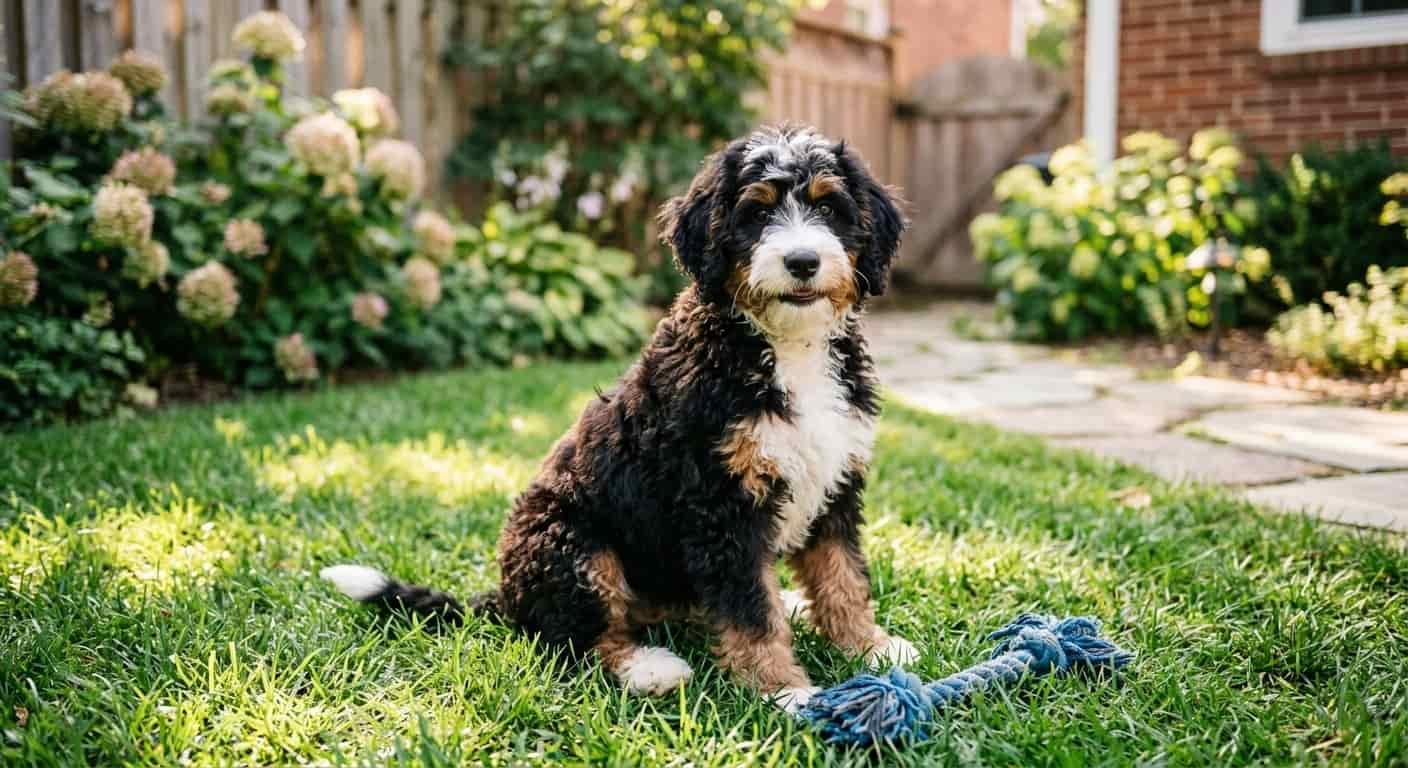
A Bernedoodle is a cross between a Bernese Mountain Dog and a Poodle. The result is a smart, affectionate dog that can look like a teddy bear — but that soft coat and sweet face come with real responsibilities that many new owners don’t expect.
Here’s something new owners often miss: two Bernedoodle puppies from the same litter can grow up completely different. One may become a 90-pound dog that needs a big yard. Another might top out under 30 pounds and do fine in an apartment. One may barely shed. Its littermate might shed all over the couch.
That’s why picking a Bernedoodle dog shouldn’t come down to the cute photo alone. This guide covers what a Bernedoodle is, how big it gets, what it’s like to live with, how much grooming and money it takes, and what to ask before you buy a puppy.
For naming a bernedoodle read our latest content.
What Is a Bernedoodle?
A Bernedoodle is a designer dog breed made by crossing a Bernese Mountain Dog with a Poodle. Breeder Sherry Rupke of Swissridge Kennels in Ontario, Canada, bred the first Bernedoodles on purpose in 2003, aiming to combine the Bernese Mountain Dog’s calm, loyal nature with the Poodle’s intelligence and lower-shedding coat.
Bernedoodle Quick Facts
A quick look at the size, coat, energy, and family traits of Bernedoodles
| Height | 12–29 inches at the shoulder, depending on size type |
| Weight | 10–100+ pounds, depending on size type |
| Lifespan | Varies by size; commonly estimated at 12–18 years, though breed-specific data is limited |
| Coat | Wavy, curly, or straight |
| Shedding | Low to moderate, but it varies from dog to dog |
| Energy | Moderate to high |
| Good with Kids | Often yes, with appropriate supervision and training |
| Best For | Families who can provide grooming, training, companionship, and daily exercise |
These figures are general patterns, not guarantees. A Bernedoodle’s actual size, coat, and personality depend on genetics, which parent it takes after more, and how it’s raised.
A note on the research behind this guide: the Bernedoodle is too new and too varied a cross for large, breed-specific studies to exist yet. So this guide draws on three kinds of evidence and tries to be clear about which is which: documented Bernedoodle/doodle research (like the 2022 owner-expectations survey cited below), well-established findings about the parent breeds (like Bernese Mountain Dog cancer risk), and general veterinary and dog-care guidance that reasonably applies to any dog, Bernedoodles included.
Bernedoodle Characteristics
The Bernedoodle pulls traits from two very different dogs. The Bernese Mountain Dog is a large, calm working breed known for loyalty and a gentle nature around family. The Poodle is highly intelligent and athletic, originally bred as a working retriever rather than just a show dog.
Because a Bernedoodle can lean toward either parent, no two are guaranteed to look or act the same. Some are calm couch companions. Others are busy and need a job to do, much like their Poodle side.
Intelligence and Trainability
Most Bernedoodles learn fast, largely thanks to the Poodle side, one of the most trainable breeds around. But a smart dog can pick up bad habits just as quickly as good ones.
If a puppy jumps on guests and gets attention for it, the puppy learns that jumping works. Reward calm behavior instead — four paws on the floor — and the dog has a reason to repeat that instead.
This idea is backed by research on dog training methods generally. A 2026 review in the Journal of Veterinary Behavior analyzed 28 documented cases where trainers used functional analysis — a method that identifies what a dog is actually getting out of a behavior — to understand problem behaviors across a range of dog breeds and mixes. The researchers pinpointed a clear cause in the large majority of cases. The takeaway applies just as well to a Bernedoodle as to any other dog: instead of only asking “how do I stop this,” ask “what is my dog getting out of doing this?” (Source)
Bernedoodle Appearance
Bernedoodles often have a “teddy bear” look, but their coat, size, and color vary a lot from dog to dog.
Coat Types
A Bernedoodle’s coat generally falls into one of three types:
- Wavy coat — the most common type. Soft, loosely waved fur that sheds lightly and is easier to maintain than a curly coat.
- Curly coat — tight, Poodle-like curls. Sheds the least, but mats fastest if it isn’t brushed often.
- Straight coat — the least common type, closer to the Bernese Mountain Dog’s natural coat. Sheds the most of the three.
A coat that sheds less usually means more brushing, not less. Loose hair that doesn’t fall out stays trapped in the coat and can turn into mats close to the skin if you skip brushing.
Colors and Patterns
Common Bernedoodle colors include:
- Black and white
- Black, white, and brown tricolor
- Sable
- Phantom
- Merle
- Apricot or cream
Tricolor Bernedoodles are especially popular because the markings resemble the classic Bernese Mountain Dog look.
One color deserves a specific warning: merle. Merle is a striking marbled pattern, but breeding two merle-carrying dogs together can produce puppies with serious hearing and vision problems. A responsible breeder will never intentionally pair two merle-carrying dogs. If a breeder can’t explain how they avoid this, treat it as a red flag.
Coat color says nothing about a dog’s health, temperament, or trainability. Don’t choose a puppy for its color alone.
Bernedoodle Size
Size is probably the single biggest question people have before getting a Bernedoodle — and it’s also the hardest to pin down, because there’s no official size standard. The Bernedoodle is a crossbreed, not a recognized breed with fixed rules, so breeders use their own labels: Standard, Medium (or Moyen), Mini, Micro Mini, and sometimes Ultra.
Bernedoodle Size Chart
These are approximate, breeder-reported categories, not an official or standardized measurement — treat the ranges below as a general guide.
Bernedoodle Size Chart
Typical height and weight ranges by Bernedoodle size
| Size Type | Height at Shoulder | Typical Weight |
|---|---|---|
| Micro Mini / Tiny | 12–17 inches | 10–25 lbs |
| Mini | 17–22 inches | 25–49 lbs |
| Medium / Moyen | 18–22 inches | 40–70 lbs |
| Standard | 23–29 inches | 65–100 lbs |
| Ultra / Extra Large | 23–29+ inches | Can exceed 100 lbs |
These figures combine commonly cited breeder ranges with general veterinary guidance on doodle sizing, and there’s real overlap between categories — a 45-pound dog might get called “Mini” by one breeder and “Medium” by another. Because there’s no industry-wide standard, always ask a breeder for:
- The actual adult weight of both parents
- The adult weight of puppies from earlier litters by the same parents
- Height at the shoulder, not just weight
Don’t rely on a size label alone, especially “Micro” or “Ultra” — these are marketing terms more than measurements.
When Do Bernedoodles Stop Growing?
Smaller Bernedoodles usually reach adult height earlier, often around 9 to 12 months. Standard-size Bernedoodles take longer, and even after they hit adult height, they can keep filling out in muscle and chest depth until they’re close to two years old. Don’t judge a growing puppy’s final size from one weigh-in — genetics, parents, and nutrition all play a role.
What Size Fits Your Life?
A Standard Bernedoodle can be a wonderful match for someone with space and time for daily exercise. A Mini is easier to handle physically but still needs real exercise and mental stimulation — small doesn’t mean low-energy. The better question isn’t “how big will it get,” it’s: can you meet this dog’s exercise, training, grooming, and vet needs for its whole life, whatever size it ends up?
How Much Does a Bernedoodle Cost?
The figures below are typical U.S. estimates compiled from breeder pricing and pet-cost research, not a fixed or official price list — actual costs vary by region and breeder.
Bernedoodle puppies typically cost $2,500 to $5,000 or more, depending on size, coat rarity, color, and the breeder’s reputation. Mini and Micro varieties, along with rare coat patterns like merle, often carry a higher price tag than standard tricolor puppies.
That purchase price is just the start. Here’s a rough first-year cost breakdown:
- Food and treats: $400–$800, more for larger Standard-size dogs
- Initial vet visits, vaccines, and spay/neuter: $300–$600
- Supplies (crate, bed, leash, bowls, toys): $200–$400
- Grooming: varies widely by coat type and size (see below)
Ongoing Grooming Cost
This is the cost new owners underestimate most, and there’s real data behind that. A 2022 peer-reviewed survey of 2,191 dog owners — including 689 doodle owners — published in the journal Animals, asked owners how their dogs fell short of expectations. Among the doodle owners who answered that question, 18.2% pointed to grooming cost or frequency, and 6.7% specifically called out how much daily brushing was required. One owner of a Bernese Mountain Dog/Poodle mix said grooming costs ended up nearly double what they expected. A 2025 published response to that study, from researchers at the Functional Dog Collaborative, cautioned that the findings should be read as one dataset, not a verdict on every doodle or every Bernedoodle (Study) (2025 response).
Professional grooming generally runs:
- Standard size: $80–$150 per visit
- Mini/Medium: $60–$100 per visit
- Micro/Tiny: $50–$80 per visit
Groomed every 6 to 8 weeks, that adds up to roughly $500 to $1,300 a year — on top of food, vet care, and supplies. A basic at-home grooming kit (slicker brush, comb, detangling spray) runs $60 to $90 and can stretch the time between professional visits if you keep up with brushing yourself.
Bernedoodle Temperament and Behavior
Many Bernedoodles are affectionate, social, and closely bonded to their families. But “Bernedoodle” doesn’t guarantee a specific personality — two puppies from the same litter can act nothing alike.
With Kids and Other Pets
Bernedoodles are often excellent with children and tend to do well with cats and other dogs when introduced properly. Still, “good family dog” doesn’t mean “automatically safe with any child in any situation.” Young kids should always be supervised around dogs, and kids should be taught how to approach, touch, and play with a dog respectfully. Every dog, no matter how friendly, needs a quiet spot to rest without being bothered.
Social and Friendly
Early socialization — introducing a puppy to new people, sounds, dogs, and situations at a pace it can handle — helps a Bernedoodle grow into a confident adult. This doesn’t mean forcing a puppy to greet everyone it meets. It means giving it positive experiences it can handle at its own speed.
Loyal, But Prone to Missing You
Bernedoodles bond hard with their people, which is part of the appeal — and part of the challenge. A dog that attached can struggle when left alone. Teaching a puppy to be comfortable by itself early, in short stretches, heads off bigger separation problems later.
Is a Bernedoodle the Best Family Dog?
There’s no single “best” family dog — the right fit hinges on your schedule. A family that’s home most evenings and weekends, ready for walks and training games, is a better match than a family that’s gone ten hours a day. Choose the dog that fits your actual life, not the dog that photographs best.
Exercise and Daily Activity
Most Bernedoodles need somewhere around an hour of physical activity a day, though the right amount shifts with age, size, and the individual dog’s energy level. A daily routine might include walks, fetch, training games, sniffing time, and puzzle toys.
Puppies are the exception — too much forced exercise, especially in larger puppies, can strain growing bones and joints. Short bursts of play are safer than long structured walks until a puppy is closer to full size.
Mental exercise matters just as much as physical exercise. Five to ten minutes of basic training — sit, down, stay, come, leave it — can tire a smart dog out faster than an extra lap around the block.
Training a Bernedoodle
Short, frequent training sessions beat long, frustrating ones. Reward the behavior you want to see, right when it happens.
Potty training: Take a puppy outside after waking up, after eating, after drinking, after play, and before bed. Reward it the moment it goes in the right spot. Accidents are normal early on — clean them up and move on rather than turning it into a punishment.
Crate training: A crate should feel like a safe space, never a punishment. Start with short stretches and build up gradually, pairing the crate with treats and calm praise.
Socialization: Ask your vet about a safe vaccination and socialization schedule, then start introducing your puppy to new people, sounds, surfaces, and situations early — gently and gradually.
Bernedoodle Grooming
Grooming is one of the biggest, and most underestimated, responsibilities of owning a Bernedoodle. A fluffy coat photographs beautifully. It also takes real, consistent work.
Grooming Schedule by Coat Type
These are practical starting points drawn from common groomer and breeder guidance, not clinical recommendations — the right routine for your dog depends on coat length, texture, and how easily it mats.
| Task | Wavy Coat | Curly Coat | Straight Coat |
| Brushing | 3–4x per week | Daily | 2–3x per week |
| Professional grooming | Every 6–8 weeks | Every 4–6 weeks | Every 8–12 weeks |
| Bathing | Every 4–6 weeks | Every 3–4 weeks | Every 6–8 weeks |
| Nail trim | Every 3–4 weeks | Every 3–4 weeks | Every 3–4 weeks |
| Ear check | Weekly | Weekly | Weekly |
Curly coats tend to mat fastest — sometimes within a day or two of skipped brushing — so near-daily brushing for curly-coated Bernedoodles is usually necessary to avoid a shave-down. Mats tend to form in the same trouble spots on every coat type: behind the ears, in the armpits, along the legs, and under the collar.
Haircuts and Bathing
Most owners use a professional groomer, especially for Standard-size dogs. A longer, fluffier “teddy bear” cut needs more upkeep than a shorter “puppy cut,” which is easier for home maintenance and cooler in summer.
Bathing frequency should follow the dog’s lifestyle, not a fixed calendar — a Bernedoodle that swims or plays outside constantly needs more baths than one that mostly lounges indoors.
Nails, Ears, and Teeth
Because Bernedoodles inherit floppy ears from the Bernese Mountain Dog side, their ears trap moisture and are prone to infections. Weekly checks and regular cleaning matter. Teach a puppy early to accept having its paws, ears, and mouth handled — it makes both grooming and vet visits far less stressful later.
Bernedoodle Health
Being a crossbreed does not make a Bernedoodle automatically healthier than a purebred dog. A 2025 journal response on designer-dog research pointed out that mixed-breed dogs can still inherit disorders from either parent breed, and being crossbred doesn’t guarantee better health on its own (Source).
Health Conditions to Know
Ask breeders directly about health testing for these conditions, which show up in Bernedoodles because they’re known issues in one or both parent breeds:
Hip and elbow dysplasia — the joint doesn’t form correctly, which causes pain and can lead to arthritis. Screened through OFA hip and elbow evaluations.
Progressive retinal atrophy (PRA) — a genetic eye disease that causes gradual vision loss, often starting with night blindness. There’s no cure, but affected dogs can still live full lives with adjustments.
Gastric dilatation-volvulus (GDV), also called bloat — a life-threatening emergency where the stomach twists. Both Bernese Mountain Dogs and Standard Poodles have deep chests, which puts Standard Bernedoodles at higher risk. Symptoms include restlessness, retching without vomiting, and a swollen belly — this calls for an emergency vet immediately, not a wait-and-see approach. Restricting hard exercise for an hour before and after meals, and using a slow-feeder bowl, can help lower the risk.
Allergies — food or environmental allergies can show up as itching, ear infections, or hair loss.
Histiocytic sarcoma and other cancers — a serious concern on the Bernese Mountain Dog side. Research from the CNRS in Rennes, France, and the AKC Canine Health Foundation puts the lifetime rate of histiocytic sarcoma in purebred Bernese Mountain Dogs at roughly 15–25%, one of the highest breed-specific cancer rates documented in dogs (Source). The risk in Bernedoodles themselves is not well established, since no comparable study has tracked histiocytic sarcoma rates in Bernedoodles specifically, and crossbreeding’s exact effect on inherited-cancer risk isn’t something research has pinned down. What’s known for certain is the risk in the purebred parent — that alone is reason enough to ask a breeder directly whether histiocytic sarcoma appears in the family line.
A responsible breeder should be able to show health testing and screening records for both parents, not just tell you the dog is “healthy.”
Are Bernedoodles Hypoallergenic?
No. No dog breed is completely hypoallergenic — the American Kennel Club states plainly that there are no 100% hypoallergenic dogs, dog breeds, or mixed breeds (Source). Some Bernedoodles, especially curly-coated ones, may shed less loose hair around the house, which can make life easier for some allergy sufferers. But dogs also release allergens through skin dander and saliva, not just shed hair, so there’s no guarantee. If allergies are a serious concern in your household, spend real time around the specific adult dog before committing, and talk to an allergist.
Do Bernedoodles Shed?
Some shed very little. Others shed noticeably more. It comes down to coat type and genetics, and there’s no way to guarantee a non-shedding puppy from a mixed litter — even with F1B or F1BB pairings that lean more toward Poodle genetics.
Bernedoodle Lifespan
Bernedoodle lifespan varies by individual and by size. Smaller dogs generally tend to live longer than larger dogs — a well-established pattern across dog breeds in general — but reliable, Bernedoodle-specific lifespan data are limited, since the cross is still fairly young and no large-scale study has tracked it the way breed registries track purebred dogs. Many owners and breeders commonly cite a range of roughly 12 to 18 years, which lines up with what’s known about mixed-breed dogs of similar size, but treat that figure as a reasonable estimate rather than a confirmed statistic. Genetics, diet, weight management, and veterinary care all influence where a specific dog falls in that range.
Nutrition and Feeding
Feed a complete, balanced dog food suited to your Bernedoodle’s life stage — puppy, adult, or senior — rather than guessing based on breed or weight alone. The American Animal Hospital Association’s nutrition guidelines recommend that treats make up no more than about 10% of a dog’s daily calories. It’s an easy rule to break during training, when treats stack up fast without anyone noticing.
Standard-size Bernedoodles, because of their deep chest, benefit from smaller, more frequent meals and a slow-feeder bowl to reduce bloat risk, along with avoiding hard exercise right around mealtimes. Regular body condition checks with your vet help catch weight gain before it becomes a joint problem.
Bernedoodle Generations Explained
You’ll see labels like F1, F1B, F1BB, F2, and Multigen when shopping for a Bernedoodle. These describe how much Poodle versus Bernese Mountain Dog ancestry a puppy has.
Bernedoodle Generations at a Glance
How each generation differs in parentage, coat, and typical shedding
| Generation | Parentage | Poodle % | Typical Coat | Shedding |
|---|---|---|---|---|
| F1 | Bernese × Poodle | 50% | Wavy | Moderate |
| F1B | F1 × Poodle | 75% | Curly or wavy | Low |
| F1BB | F1B × Poodle | 87.5% | Curly | Very low |
| F2 | F1 × F1 | ~50% | Variable | Low–moderate |
| Multigen | Multiple Bernedoodle generations | Varies | More predictable | Low |
More Poodle percentage generally means less shedding and a curlier coat — but genetics don’t follow a strict formula, and a generation label never guarantees a specific outcome. Two F1B puppies from the same litter can still have different coats.
Bernedoodle Pros and Cons
Pros
- Often affectionate and people-focused
- Highly trainable, thanks to the Poodle side
- Available in a range of sizes
- Coat can shed less than many breeds
- Playful, intelligent, good with families
Cons
- Grooming is time-consuming and can get expensive
- Coat type and shedding level aren’t fully predictable, even within a litter
- Larger Bernedoodles need space and strength to handle on a leash
- Can struggle with being left alone
- Real risk for hip/elbow dysplasia, bloat, and certain cancers
- “Hypoallergenic” is never guaranteed
Puppy vs. Adult Bernedoodle
A puppy means potty training, chewing, socialization, and interrupted sleep — real work, especially in the first six months. An adult Bernedoodle, whether from a rescue or a rehoming situation, often already has basic training and a settled personality, which can suit people who want the companionship without the puppy stage. Neither option is automatically the right answer — it comes down to how much time you have to invest upfront.
How to Choose a Bernedoodle Breeder
The breeder matters as much as the puppy. Before putting down a deposit, ask:
- What health tests have both parents had, and can I see the documentation?
- What are the parents’ adult weights and heights?
- What size and coat types have shown up in earlier litters from this pairing?
- How are puppies socialized before going home?
- What vaccination and deworming records will I receive?
- What happens if my puppy develops a serious inherited health problem?
- Can I meet the mother, and see where the puppies are raised?
- What support do you provide after I bring the puppy home?
Breeder Red Flags
Be cautious of a breeder who:
- Won’t share health testing records
- Always has puppies available, with no waitlist
- Focuses heavily on rare colors like merle without discussing merle-to-merle breeding risk
- Guarantees a completely non-shedding or hypoallergenic puppy
- Pushes you to put down a deposit quickly
- Won’t let you see the parents or the raising environment
A good breeder talks openly about health risks, temperament variation, and the real day-to-day work of owning a Bernedoodle — not just the highlights.
A Brief History of the Bernedoodle
The Bernedoodle is a relatively young crossbreed. Breeder Sherry Rupke of Swissridge Kennels in Ontario intentionally bred the first Bernedoodles in 2003, aiming to combine the Bernese Mountain Dog’s gentle temperament with the Poodle’s intelligence and coat. The Bernedoodle isn’t recognized by the American Kennel Club, but organizations like the Designer Breed Registry do recognize it. In just over two decades, it’s become one of the most sought-after doodle crosses in North America.
Frequently Asked Questions About Bernedoodles
What is a Bernedoodle? A cross between a Bernese Mountain Dog and a Poodle, first intentionally bred in 2003.
How big does a Bernedoodle get? Anywhere from about 10 to over 100 pounds, depending on size type — Micro, Mini, Medium, or Standard. Ask breeders for actual parent weights rather than relying on size labels alone.
How much does a Bernedoodle cost? Typically $2,500 to $5,000 or more for the puppy, plus ongoing costs for food, vet care, and grooming — professional grooming alone can run $500 to $1,300 a year.
Are Bernedoodles hypoallergenic? No dog is fully hypoallergenic. Some Bernedoodles shed less than others, which may help some allergy sufferers, but there’s no guarantee.
Do Bernedoodles shed? It varies by dog and coat type. Curly coats shed the least; straight coats shed the most.
Are Bernedoodles easy to train? Generally yes, thanks to the Poodle side, but they still need consistent rewards-based training and early socialization.
How often should a Bernedoodle be groomed? It depends on coat type — anywhere from daily brushing for curly coats to a few times a week for straighter coats, plus professional grooming every 4 to 12 weeks.
What’s the difference between F1 and F1B Bernedoodles? An F1 is a first-generation 50/50 cross. An F1B is an F1 bred back to a Poodle, giving it roughly 75% Poodle ancestry and usually less shedding.
How long do Bernedoodles live? Often estimated at 12 to 18 years, with smaller dogs tending to live longer, though reliable Bernedoodle-specific lifespan data is limited.
Are Bernedoodles good for first-time owners? They can be, but new owners should go in clear-eyed about the grooming, training, and exercise commitment — it’s not a low-maintenance breed just because it looks soft and cuddly.
Do Munchkin Bernedoodles need a special diet? Not necessarily, but Munchkin Bernedoodles need balanced, portion-controlled meals suited to their age, weight, activity level, and individual health needs. Because their adult size can vary, avoid assuming that every Munchkin Bernedoodle needs the same amount of food. Choose a complete and balanced dog food appropriate for their life stage, monitor their weight, and ask your veterinarian for personalized feeding advice. If you’re considering this smaller Bernedoodle type, learn more about Munchkin Bernedoodles and their potential size and care needs before choosing one.
Final Thoughts
Bernedoodles can be loving, clever, beautiful dogs — but their biggest selling point is also their biggest responsibility. Size, coat, and temperament vary widely, even within the same litter, so there’s no way to guarantee exactly what you’re getting from a photo alone.
Before bringing one home, think past the puppy stage. Think about the adult size you might end up with. Think about the weekly brushing, the grooming bills, the daily walks, and the vet visits. A Bernedoodle that fits your actual life — not just your Pinterest board — is far more likely to become the dog you hoped for.
For Any query click the button