
A Munchkin Bernedoodle is a smaller Bernedoodle type, but there is an important catch: “Munchkin Bernedoodle” is not a standardized breed name with one official size, pedigree, or genetic recipe.
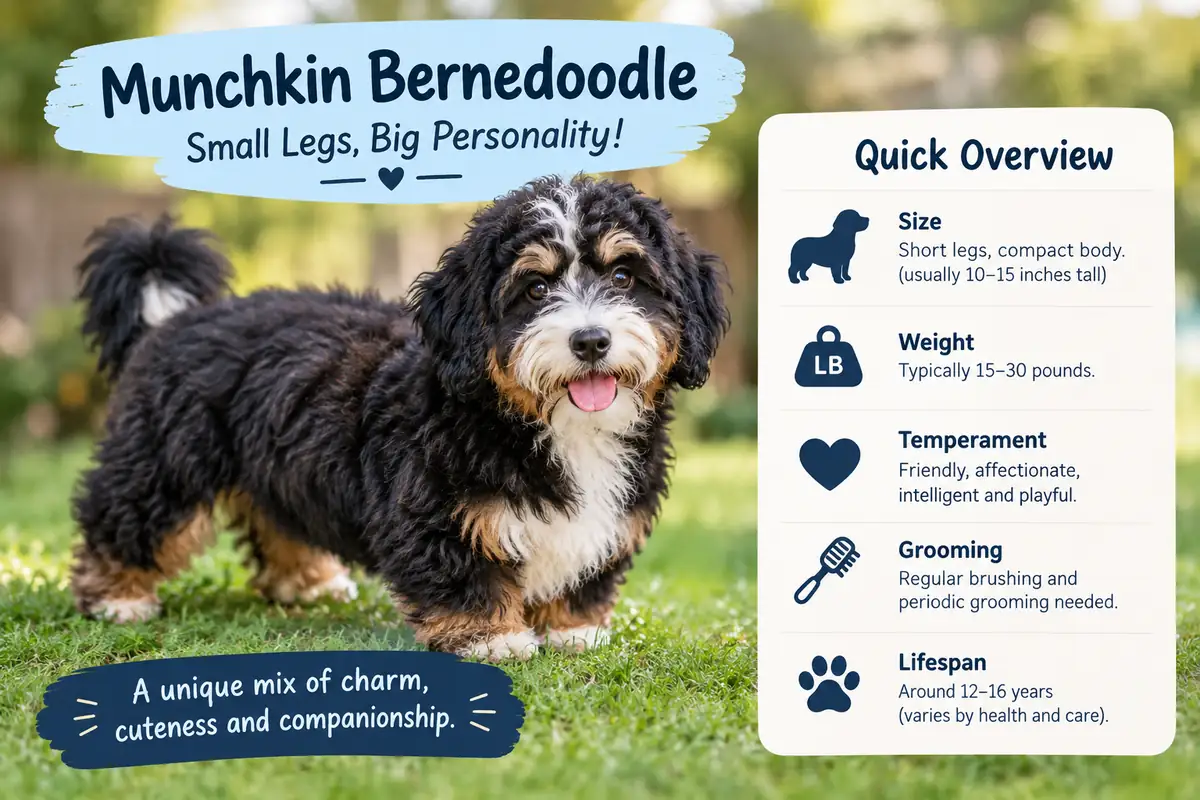
Some breeding programs use Cavalier King Charles Spaniel genetics to create a compact Bernedoodle. Others use “Munchkin” for a Bernedoodle with noticeably shorter legs and a longer body. Because of that, two dogs sold under the same name can have different adult weights, proportions, ancestry, and health considerations.
That is why the label alone does not tell you everything.
If you’re considering one, look at the actual parents, pedigree, expected adult size, health testing, and the genetic variants the breeder is selecting for.
This guide explains what a Munchkin Bernedoodle is, how big it can get, how it differs from a Mini Bernedoodle, what the Cavalier influence means, and what to know about health, grooming, exercise, training, and lifespan.
Munchkin Bernedoodle at a Glance
| Feature | What to Know |
|---|---|
| Type | Designer mixed-breed dog |
| Core ancestry | Bernese Mountain Dog + Poodle |
| Additional ancestry in some programs | Cavalier King Charles Spaniel |
| Official breed standard | None |
| Adult size | Varies considerably by breeding program |
| Common coat types | Wavy, curly, or straighter |
| Common colors | Tri-color, black and white, chocolate, sable, merle and others |
| Temperament | Often affectionate, social, playful and people-oriented |
| Grooming | Regular brushing plus professional grooming |
| Exercise | Daily walks, play and mental stimulation |
| Lifespan | No scientifically established Munchkin-specific average |
| Important health topic | Ask about both general Bernedoodle health and the specific genetics behind short legs |
What Is a Munchkin Bernedoodle?
A Munchkin Bernedoodle is a designer mixed-breed dog marketed as a smaller or short-legged Bernedoodle.
A traditional Bernedoodle combines a Bernese Mountain Dog and a Poodle. The Bernese Mountain Dog originated in Switzerland and was developed as a working farm dog. The Poodle contributes intelligence, trainability and coat characteristics.
The “Munchkin” part is not an official breed classification.
Some breeders specifically use Cavalier King Charles Spaniel genetics in their Munchkin programs. For example, Rocky Road Doodles describes its Munchkin program as using Cavalier infusion and reports adult dogs generally in the small range, while Boise Doodle Co describes Munchkins differently, emphasizing a short-legged Bernedoodle structure. These are individual breeder definitions, not an industry-wide standard.
That distinction is important when comparing puppies.
Why the Name Can Be Confusing
There is no AKC breed standard that says:
“A Munchkin Bernedoodle must weigh X pounds, stand X inches, and have X percentage of Cavalier, Bernese and Poodle.”
Instead, breeders have developed their own programs and terminology.
You may therefore see names such as:
- Munchkin Bernedoodle
- Mini Munchkin Bernedoodle
- Cavalier Bernedoodle
- Cavabernedoodle
- Petite Bernedoodle
- Micro Mini Bernedoodle
Those names can overlap, and their meanings depend on the breeder.
The safest approach is to evaluate the genetics and parents rather than relying on the marketing name.
What Breeds Are Behind a Munchkin Bernedoodle?
The core Bernedoodle ancestry is:
Bernese Mountain Dog + Poodle
Some Munchkin programs add:
Cavalier King Charles Spaniel
The Cavalier is itself a small breed. The AKC lists adult Cavaliers at about 12–13 inches tall and 13–18 pounds, with a published life expectancy of 12–15 years.
The Bernese Mountain Dog is dramatically larger. AKC lists males around 25–27½ inches and 80–115 pounds, while females are around 23–26 inches and 70–95 pounds.
That huge difference helps explain why breeders use different generations and parent combinations when developing smaller Bernedoodles.
But there is no fixed three-breed formula that defines every Munchkin Bernedoodle.
How Is a Munchkin Bernedoodle Created?
There isn’t one universal breeding recipe.
Depending on the program, a breeder may use:
- Smaller multigenerational Bernedoodles
- Miniature or Toy Poodle ancestry
- Cavalier King Charles Spaniel ancestry
- Several generations of selective breeding
- A combination of these approaches
Adult size can be influenced by many factors, including:
- Parent size
- Generation
- Poodle variety
- Cavalier ancestry
- Overall pedigree
- Sex
- Individual genetics
- Nutrition and growth
This is why a breeder should be able to show you the adult sizes of parents and, ideally, previous offspring from related lines.
Munchkin Bernedoodle Size: How Big Do They Get?
A Munchkin Bernedoodle does not have one guaranteed adult size. Published breeder ranges vary widely, so the parents and breeding program matter more than the word “Munchkin.”
For example, Rocky Road Doodles currently reports Munchkins generally around 15–25 pounds, while its more detailed guide describes a typical 10–25-pound range. Boise Doodle Co has published a broader range, including programs producing dogs around 20–35 pounds and another guide describing 20–45 pounds.
These numbers should be treated as breeder-reported examples, not a breed standard.
What About Height?
Height can vary just as much.
Some programs report dogs around 9–15 inches at the shoulder, while other Munchkin programs may produce taller or heavier dogs.
The unusual body proportions are often part of the reason people use the word “Munchkin” in the first place.
What Will My Puppy Weigh as an Adult?
No breeder can guarantee an exact adult weight.
A better question is:
“How much do adult dogs from this exact parent pairing and related lines weigh?”
Ask for:
- Mom’s adult weight
- Dad’s adult weight
- Adult weights of previous offspring
- The puppy’s generation
- Expected adult size range
- Any unusually large or small dogs in the pedigree
That gives you a much better picture than a puppy’s current weight.
Munchkin Bernedoodle vs. Mini Bernedoodle
These names are often confused, but they can describe different breeding goals.
| Feature | Munchkin Bernedoodle | Mini Bernedoodle |
|---|---|---|
| Standardized definition | No | No single universal size standard |
| Main goal | Smaller and/or shorter-legged Bernedoodle | Smaller Bernedoodle |
| Cavalier genetics | Sometimes used | Usually not required |
| Short-legged structure | May be part of the goal | Not necessarily |
| Adult size | Highly variable | Highly variable |
| Body proportions | May include shorter legs relative to body | Generally more conventional proportions |
| Best way to compare | Examine pedigree and genetics | Examine pedigree and genetics |
So a Munchkin is not simply a Mini Bernedoodle that happens to be smaller.
A Mini Bernedoodle can be produced by selecting smaller Bernese/Poodle lines. A Munchkin program may use a different genetic strategy.
Munchkin Bernedoodle Temperament
Munchkin Bernedoodles are often described as:
- Affectionate
- Social
- Playful
- Intelligent
- People-oriented
- Trainable
- Companion-focused
But temperament is not guaranteed by a label.
Bernese Mountain Dogs are generally known for being affectionate and sensitive, while Cavaliers are companion-oriented dogs that often enjoy close human contact. Poodles are highly intelligent and generally responsive to training.
The combination can produce a dog that wants to participate in family life rather than spend most of the day alone.
Are They Good Family Dogs?
They can be a good fit for families, but the individual dog’s temperament and the family’s handling matter more than the designer label.
Children should learn how to approach, touch and play with dogs respectfully.
A smaller dog is also not automatically safer around young children. A child can accidentally hurt a small puppy, while an excited puppy can scratch or nip.
Supervision matters.
Can a Munchkin Bernedoodle Live in an Apartment?
Potentially, yes.
A smaller body can make apartment living easier, but small does not mean maintenance-free.
A dog living in a Manhattan apartment still needs walks, toilet breaks, training, play and mental stimulation. The same is true whether you’re living near Central Park or in a suburban home with a fenced yard.
Coat, Colors and Shedding
Munchkin Bernedoodles can have:
- Wavy coats
- Curly coats
- Straighter coats
- Furnished coats
Color possibilities may include:
- Traditional Bernese-style tri-color
- Black and white
- Chocolate
- Sable
- Merle
- Phantom patterns
The exact appearance depends on the parents and genetics.
Does a Munchkin Bernedoodle Shed?
Many Bernedoodles have reduced shedding because of Poodle-related coat genetics, but low shedding is not guaranteed.
The furnishings gene is particularly important. UC Davis explains that an RSPO2 variant is associated with the furnished coat seen in many Poodle and Poodle-cross dogs. Shedding itself is more complicated and involves multiple genes, including MC5R and RSPO2.
So don’t assume:
more Poodle = automatically no shedding.
Genetic testing and the actual coat of the parents provide better information.
Are They Hypoallergenic?
No dog is completely hypoallergenic.
Dog allergens come from proteins found in things such as skin flakes, saliva and urine, not simply from visible hair.
A lower-shedding coat may reduce the amount of hair and dander spread around the home, but it does not eliminate allergens.
If allergies are a serious concern, spend time around adult dogs from the same line before committing to a puppy.
Munchkin Bernedoodle Health Issues
This is one area where buyers should look beyond the cute teddy-bear appearance.
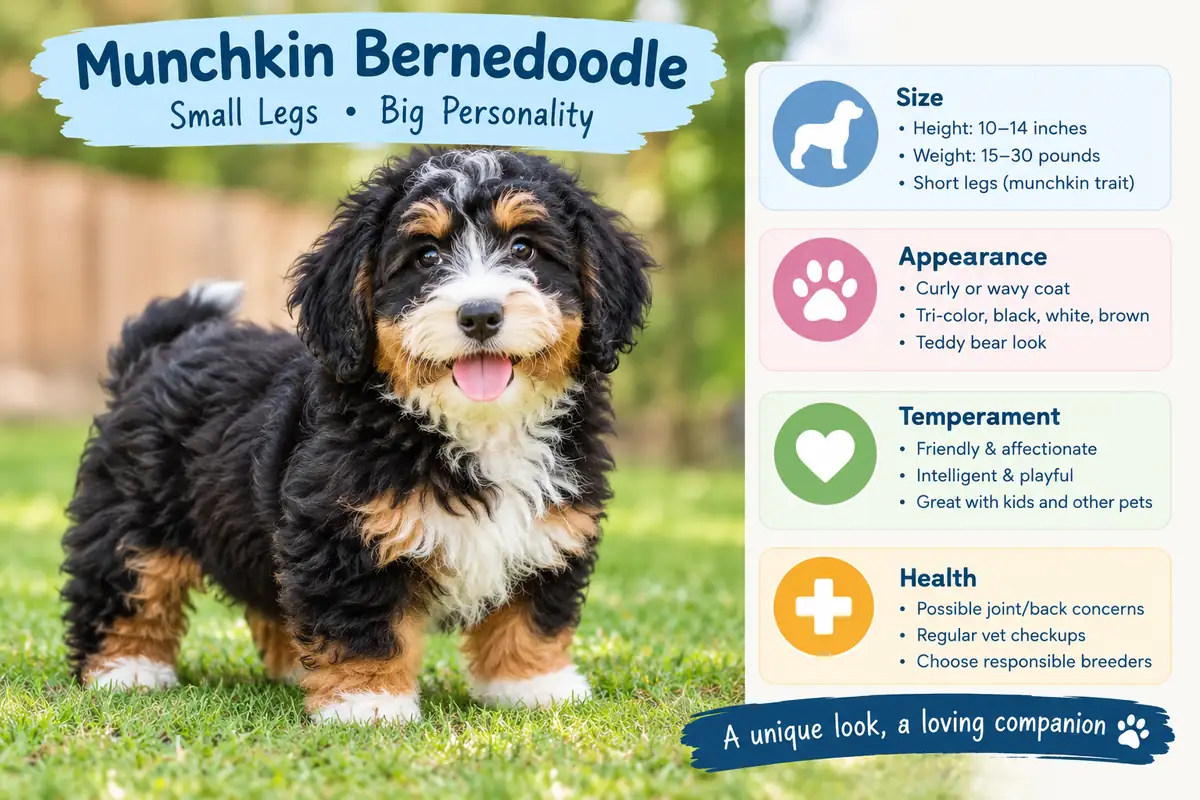
Potential health concerns can come from all parts of the pedigree.
Depending on the parents, breeders may consider screening for:
- Hip dysplasia
- Elbow dysplasia
- Patellar luxation
- Eye disorders
- Cardiac disease
- Progressive retinal atrophy
- Degenerative myelopathy
- Von Willebrand disease
- Other breed-relevant inherited disorders
This does not mean every Munchkin Bernedoodle will develop these conditions.
It means responsible breeding should consider the health risks present in the dogs being combined.
The Short-Leg Genetics Need Special Attention
This is where the word “Munchkin” deserves a more technical explanation.
Researchers have identified two different FGF4 retrogenes in dogs.
One is associated with chromosome 12 (CFA12) and is known as CDDY. It is associated with shortened limbs and premature intervertebral disc degeneration and therefore increased susceptibility to Hansen type I IVDD.
The other is associated with chromosome 18 (CFA18) and is known as CDPA. It also affects limb length but has a different relationship with IVDD. UC Davis specifically distinguishes the two variants.
This distinction matters because you cannot assume that every short-legged Munchkin carries the same FGF4 variant.
If a breeder tells you that a puppy has a short-legged phenotype, ask:
- Which FGF4 variant was tested?
- Was CFA12 CDDY tested?
- Was CFA18 CDPA tested?
- How many copies were found?
- What are the results for both parents?
- What breeding strategy is being used?
What Does CDDY Mean for IVDD?
A major 2017 study by Brown and colleagues identified the CFA12 FGF4 retrogene and reported an odds ratio of 51.23 (95% CI 46.69–56.20) for IVDD in the study population. That is an odds ratio from genetic research across dogs; it should not be presented as saying that a Bernedoodle carrying the variant has a 51-times-greater personal chance of developing IVDD.
Later research also found that the CFA12 variant was associated with earlier age at IVDD surgery, while the CFA18 variant had a different and much smaller effect in that study.
The practical takeaway is simple:
Short-legged structure deserves genetic context, not fear.
A genetic result is a risk factor. It is not a diagnosis and does not tell you exactly what will happen to an individual dog.
Cavalier-Related Health Considerations
If a Munchkin program includes Cavalier King Charles Spaniel genetics, buyers should also ask about health conditions associated with that breed.
Two important examples are:
Myxomatous Mitral Valve Disease
Cavaliers are predisposed to myxomatous mitral valve disease (MMVD), a progressive heart condition involving degeneration of the mitral valve.
A 2024 study in the Journal of Veterinary Internal Medicine described MMVD as highly prevalent in Cavalier King Charles Spaniels.
This is one reason cardiac screening matters when Cavalier genetics are part of a breeding program.
Syringomyelia
Cavalier King Charles Spaniels are also predisposed to syringomyelia, a neurological condition involving fluid-filled cavities within the spinal cord.
Research describes syringomyelia as a heritable condition with variable expression, meaning genetic risk does not guarantee clinical disease.
Again, the important point is not that every Munchkin Bernedoodle will develop these conditions.
The point is that adding Cavalier ancestry adds another set of health considerations that a responsible breeder should understand.
What Health Testing Should a Breeder Provide?
A DNA test is useful, but a DNA panel is not the same thing as complete health testing.
Depending on the individual parents and their breeds, responsible screening may include:
| Test | What it helps evaluate |
|---|---|
| Hip evaluation | Hip structure and dysplasia risk |
| Elbow evaluation | Elbow joint abnormalities |
| Patella evaluation | Kneecap stability |
| Eye examination | Inherited and structural eye disease |
| Cardiac evaluation | Heart abnormalities |
| DNA testing | Specific inherited variants |
| CDDY/CDPA testing | FGF4-related skeletal genetics |
| Pedigree review | Health patterns across generations |
The exact testing plan should be appropriate for the parents.
Don’t settle for:
“Our dogs are health tested.”
Ask to see the actual results.
Some breeders publish extensive records. For example, Rocky Road Doodles publicly lists health results for individual dogs, including patella, cardiac, hip and DNA testing. That is useful as an example of the type of documentation a buyer can ask to see, although one breeder’s records should not be treated as a universal standard.
Munchkin Bernedoodle Lifespan
There is no large scientific dataset establishing a definitive average lifespan specifically for Munchkin Bernedoodles.
Breeder estimates commonly fall around the low-to-mid teens, but those figures should be treated as estimates rather than established breed statistics.
For context:
- AKC lists the Cavalier King Charles Spaniel at 12–15 years.
- AKC lists the Bernese Mountain Dog at roughly 7–10 years.
A mixed-breed dog’s actual lifespan can vary substantially.
Factors include:
- Genetics
- Adult size
- Inherited disease risk
- Weight management
- Nutrition
- Dental care
- Preventive veterinary care
- Exercise
- Environment
- Individual variation
So if someone promises an exact lifespan for a Munchkin Bernedoodle, be skeptical.
Grooming and Coat Care
Most Munchkin Bernedoodles need regular coat maintenance.
A practical routine includes:
Brush regularly
Aim for several brushing sessions each week, especially if the coat is curly or dense.
Pay extra attention to:
- Behind the ears
- Armpits
- Collar area
- Legs
- Tail
- Around the rear
- Between the toes
These are common places for mats to develop.
Professional grooming
Many doodle-type coats need professional grooming every several weeks. The exact interval depends on coat length, texture and how consistently the dog is brushed.
Don’t forget dental care
Small dogs can be prone to dental crowding and periodontal problems.
Start tooth brushing early and discuss veterinary dental care with your veterinarian.
Start grooming training as a puppy
Touch the paws.
Handle the ears.
Look inside the mouth.
Run a brush through the coat.
Reward calm behavior.
This makes future grooming appointments much easier.
How Much Exercise Does a Munchkin Bernedoodle Need?
Think daily activity plus mental stimulation, rather than a fixed number of miles.
A typical adult may enjoy:
- Walks
- Sniffing time
- Fetch
- Short hikes
- Puzzle toys
- Training games
- Indoor play
A walk through a neighborhood park can be just as useful as a long-distance outing.
For example, a Munchkin Bernedoodle living near Golden Gate Park in San Francisco could get plenty of enrichment from controlled walks, sniffing and training without needing to run for miles every day.
Young puppies need age-appropriate activity. Don’t force a growing puppy into long runs or repetitive high-impact exercise simply because the puppy seems energetic.
Training a Munchkin Bernedoodle
These dogs can be highly trainable, but intelligence doesn’t mean automatic obedience.
Start with:
- Name recognition
- Potty training
- Crate training
- Sit
- Down
- Come
- Leave it
- Loose-leash walking
- Calm greetings
- Grooming handling
Use positive reinforcement.
Reward the behavior you want to see.
Bernese Mountain Dogs can be sensitive, and harsh corrections can damage trust. A calm, consistent training approach is usually more productive.
Socialization Matters Too
A well-socialized puppy should gradually experience:
- Different people
- Friendly dogs
- Car rides
- Household sounds
- Different surfaces
- Grooming
- Veterinary handling
- New environments
- Doorbells
- Vacuum cleaners
The goal is not to overwhelm the puppy.
The goal is to teach the puppy:
“New things are normal, and my person keeps me safe.”
Is a Munchkin Bernedoodle Right for Your Lifestyle?
A Munchkin Bernedoodle may suit someone who wants a relatively compact companion but still wants an active, social dog.
It can work in:
- Apartments
- Condos
- Small homes
- Suburban houses
- Larger homes
But size is only one part of the decision.
Before getting one, ask yourself:
- Can I provide daily exercise?
- Can I provide companionship?
- Can I afford professional grooming?
- Can I manage regular veterinary care?
- Am I prepared for possible inherited health problems?
- Do I have time for training?
- Can I handle a dog that may dislike being alone for long periods?
A 15-pound dog can still have a 15-pound personality.
How Much Does a Munchkin Bernedoodle Cost?
There is no standard national price for a Munchkin Bernedoodle.
Breeder pricing can vary substantially based on pedigree, location, health testing, coat, markings, breeding program and demand.
For example, Rocky Road Doodles currently publishes Munchkin prices ranging from roughly $5,000 to $10,000+, with premium dogs starting above that level. That is a specific breeder’s pricing, not a market-wide Munchkin Bernedoodle price.
If you are comparing breeders, don’t use price alone.
Compare:
| Factor | What to Ask |
|---|---|
| Health testing | Can I see the results? |
| Parents | What are their adult weights? |
| Pedigree | How many generations are documented? |
| Genetics | Which CDDY/CDPA and other tests were performed? |
| Socialization | How are puppies raised? |
| Veterinary care | What care does each puppy receive before going home? |
| Contract | What health guarantee and return policy are provided? |
| Support | What happens if I have problems after bringing the puppy home? |
A lower price does not automatically mean a bad breeder, and a high price does not automatically mean a responsible one.
A Real-World Example of Why the Label Matters
Consider two breeder programs.
Rocky Road Doodles describes its Munchkin as a Cavalier-influenced Bernedoodle and publishes small adult weights.
Boise Doodle Co describes Munchkins differently and reports adult sizes that can reach the 20–35-pound range in its program.
Neither number should be treated as the Munchkin Bernedoodle size.
Instead, these examples demonstrate something important:
The same name can describe different breeding programs.
That’s why buyers should ask for the actual pedigree, parent weights, previous offspring data and genetic testing.
Munchkin, Mini, Petite and Other Small Bernedoodle Names
You may encounter several labels while researching small Bernedoodles.
| Name | What it may mean |
|---|---|
| Mini Bernedoodle | Smaller Bernedoodle, often using smaller Poodle genetics |
| Munchkin Bernedoodle | Smaller and/or shorter-legged Bernedoodle; definition varies |
| Mini Munchkin | Smaller Munchkin label used by some breeders |
| Petite Bernedoodle | Marketing term for a smaller Bernedoodle |
| Micro Mini | Very small Bernedoodle marketing term |
| Cavabernedoodle | Bernedoodle-type dog with Cavalier ancestry |
| Cavalier Bernedoodle | Another Cavalier-influenced name |
These terms are not interchangeable by default.
Always ask the breeder what their particular term means.
Frequently Asked Questions
What is a Munchkin Bernedoodle?
A Munchkin Bernedoodle is a small or short-legged Bernedoodle type. Some breeding programs use Cavalier King Charles Spaniel genetics, while others emphasize a short-legged Bernedoodle structure. There is no single official definition.
How big does a Munchkin Bernedoodle get?
There is no standardized adult size. Published breeder examples range from very small dogs around 10–25 pounds to programs reporting adults around 20–35 pounds or more. Parent size and pedigree are better predictors than the label itself.
What is a full-grown Munchkin Bernedoodle’s weight?
The full-grown weight varies by breeding program and genetics. Ask for the adult weights of both parents and previous puppies from the same or closely related lines.
Is a Mini Munchkin the same as a Mini Bernedoodle?
Not necessarily. “Mini Munchkin” usually refers to a smaller Munchkin program, while “Mini Bernedoodle” generally refers to a smaller Bernedoodle. Neither term has one universal size definition.
How long do Munchkin Bernedoodles live?
There is no scientifically established Munchkin-specific lifespan. Individual lifespan depends on genetics, size, health, veterinary care and other factors.
Do Munchkin Bernedoodles have health problems?
They can inherit health risks from their Bernese Mountain Dog, Poodle and, in some programs, Cavalier ancestry. Short-legged lines also require careful attention to FGF4-related genetics and IVDD risk.
Are Munchkin Bernedoodles hypoallergenic?
No. No dog is completely hypoallergenic. Some may shed less than other dogs, but people with allergies can still react to them.
Are Munchkin Bernedoodles easy to train?
Many are intelligent and responsive to positive reinforcement, but individual temperament varies. Early training and socialization are important.
Are Munchkin Bernedoodles good family dogs?
They can be affectionate family companions, but suitability depends on the individual dog’s temperament, socialization and the family’s ability to provide training, exercise and supervision.
How much does a Munchkin Bernedoodle cost?
Prices vary widely by breeder and program. Published breeder examples can reach several thousand dollars and, in some programs, more than $10,000. Treat breeder-published prices as individual program pricing rather than a universal market rate.
Final Thoughts
The most important thing to understand about a Munchkin Bernedoodle is that the name does not tell the whole story.
There is no AKC standard defining exactly how big one should be, which breeds must be included, or which genetic variant creates the short-legged appearance.
Some programs use Cavalier genetics. Others use different Bernedoodle lines and focus on short-legged structure. That means the healthiest way to evaluate a puppy is to look beyond the label.
Before choosing one, ask about:
- The exact pedigree
- Adult parent weights
- Previous offspring sizes
- Hip and elbow evaluations
- Eye and cardiac screening
- Breed-relevant DNA testing
- CDDY and CDPA results where appropriate
- Cavalier-related health screening when Cavalier ancestry is present
- The breeder’s long-term breeding goals
The cute face is only the beginning.
The genetics, health testing, structure, temperament and quality of the breeding program are what deserve the closest look.