
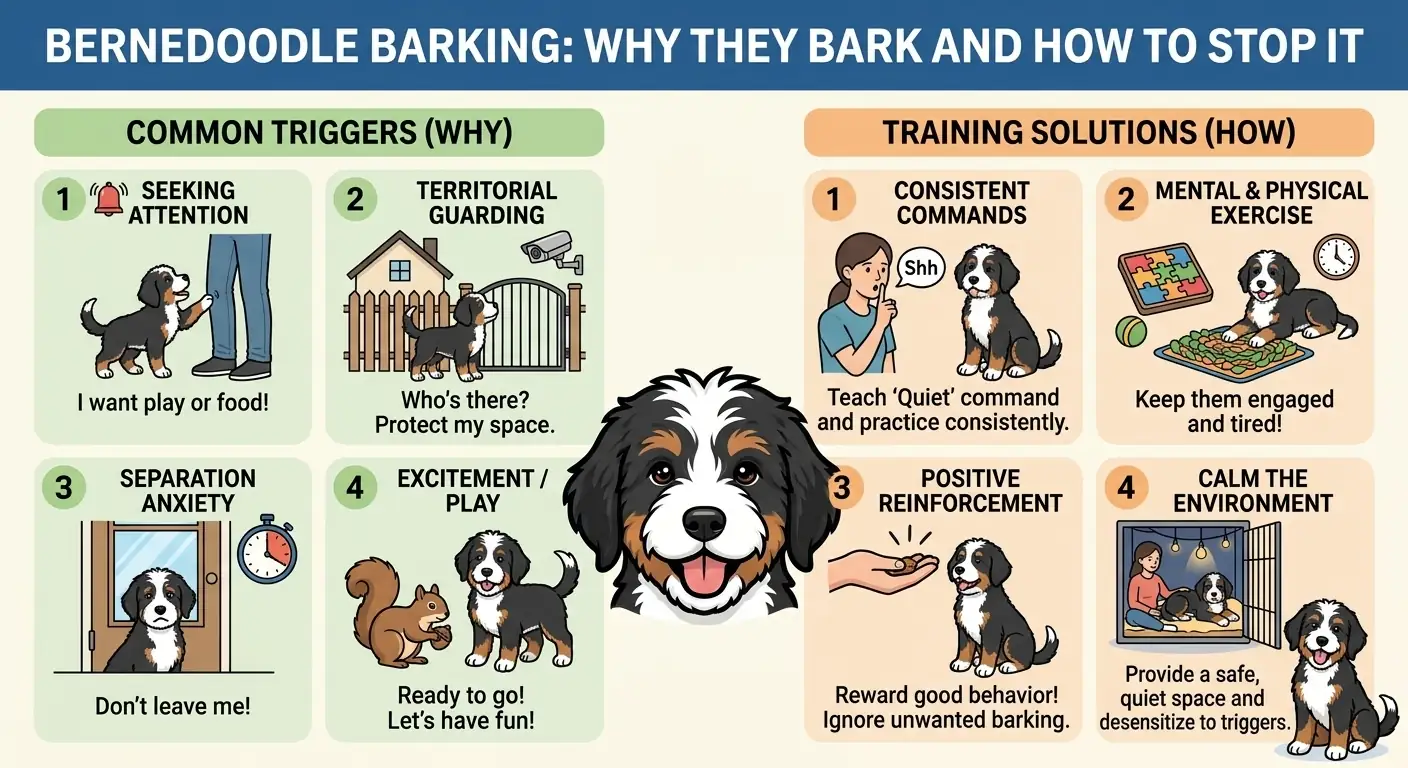
Bernedoodle Barking: Why They Bark and How to Stop It
Your Bernedoodle was the quiet, cuddly teddy bear you hoped for. Then the doorbell rang. Or a jogger passed the window. Or a leaf moved. Suddenly that calm puppy turned into a non-stop alarm system.
The good news: most Bernedoodles aren’t naturally big barkers. When they bark a lot, there’s almost always a reason, and almost every reason can be trained.
Quick answer: Bernedoodles usually have a low to moderate barking level. Most excessive barking comes from boredom, attention-seeking, excitement or uncertainty around strangers. To stop it:
- Find what triggers the barking.
- Stop rewarding it, including by yelling.
- Teach a “quiet” cue with treats.
- Slowly get your dog used to its triggers, like strangers and the doorbell.
- Give your dog more exercise and mental work.
Punishment, shouting and shock or spray collars tend to make barking worse, not better.
Below, we’ll cover how much Bernedoodles bark, which puppy sounds are normal, why some Bernedoodles bark at everything, and step-by-step plans for puppies and for barking at strangers.
Do Bernedoodles bark a lot? (Bernedoodle barking level)
Most Bernedoodles are not big barkers. Their barking level usually sits somewhere between low and moderate, depending on which parent they take after.
| Parent breed | Barking tendency | With strangers |
|---|---|---|
| Bernese Mountain Dog | Quiet. VCA Animal Hospitals rates its barking 1 out of 5 | “Somewhat aloof” with strangers |
| Poodle | Usually quiet, but alert. Purina notes it “barks and alerts to visitors” | Often makes a good watchdog |
| Bernedoodle | Low to moderate | Varies; often barks to announce visitors |
Sources: VCA Animal Hospitals, Purina
In practice, this means a typical Bernedoodle won’t bark for no reason. But many will bark to alert you when someone comes to the door, and some take that job very seriously.
Every Bernedoodle is an individual. Two puppies from the same litter can have very different “voices,” and how a puppy is raised matters as much as its genes. Early socialization, enough exercise and consistent training are what keep most Bernedoodles calm and quiet.
What sounds do Bernedoodle puppies make?
Bernedoodle puppies are surprisingly chatty. Most of their sounds are normal communication, not a problem to fix.

| Sound | What it usually means | What to do |
|---|---|---|
| Whining or crying | Needs a potty break, is lonely, tired, or settling into a crate | Check basic needs first, then wait for a quiet moment before letting them out |
| Yipping or high-pitched barks | Excitement, play, or wanting attention | Calmly end play for a few seconds if it gets too wild |
| Play growling | Normal during tug or wrestling games | Fine if the body is loose and wiggly; pause the game if it gets stiff |
| Howling | Reacting to sirens or music, or feeling alone | Usually harmless; build alone time slowly |
| Grumbling or “talking” | Stretching, settling down, or asking for something | Normal, and often very cute |
| Sharp, repeated barks | Alarm at a new sound, person or object | Calmly check it out, then reward quiet (see below) |
A puppy that cries a lot in its crate during the first nights is normal. A crate in your bedroom, a warm blanket and a calm routine help. Our free puppy schedule builder on the Bernedoodle puppy guide can help you plan naps and potty breaks, so your puppy cries less from being overtired or needing to go out.
Call your vet if your puppy suddenly yelps when touched, cries while eating or going to the bathroom, or becomes unusually quiet. Those can be signs of pain or illness rather than behavior.
Why does my Bernedoodle bark at everything?
A Bernedoodle that “barks at everything” is usually barking for one or two reasons, again and again. The American Kennel Club lists the most common ones as attention-seeking, boredom, fear, excitement, frustration and territorial barking. Spotting which type you’re dealing with tells you which fix will work.
| Type of barking | What it looks like | Common Bernedoodle triggers |
|---|---|---|
| Alert or territorial | Sharp barks at the window or door, body stiff and facing the trigger | Doorbell, delivery drivers, people walking past |
| Attention-seeking | Barks while looking right at you, stops when you respond | You on the phone, dinner time, the toy under the couch |
| Boredom | Repetitive, steady barking, often when alone or in the yard | Too little exercise or mental work |
| Excitement | High-pitched barks, wagging, jumping | Guests arriving, walks, playtime |
| Fear or uncertainty | Barking while backing away, tail low, ears back | Strangers, hats, umbrellas, loud trucks |
| Frustration | Barking when it can’t reach something | Other dogs on walks, squirrels, a closed gate |
Bernedoodles are smart, people-focused dogs. That makes them quick to learn that barking gets results. If barking once got them a treat, a game or even a “Shh!” from you, they’ll try it again.
Their Bernese side can also make some Bernedoodles a little reserved with people they don’t know. Without enough positive experiences with strangers as a puppy, that caution can turn into barking.
How to stop a Bernedoodle puppy from barking
Puppy barking is easiest to fix early, before it becomes a habit. Work through these steps in order.
1. Meet their needs first. Many barking puppies are simply tired, bored or need to go out. Make sure your puppy has regular potty breaks, enough play and plenty of naps. Overtired puppies bark and bite more, just like toddlers get cranky.
2. Stop rewarding the barking. If your puppy barks for attention, don’t look at them, talk to them or touch them until they’re quiet. The AKC notes that even yelling counts as attention, and your puppy may hear it as you “barking” along. Turn away, wait for a few seconds of silence, then reward the quiet.
3. Reward quiet moments. Catch your puppy being calm. When they’re lying quietly, calmly drop a treat between their paws. You’re teaching them that silence is what pays.
4. Teach a “quiet” cue.
- Wait for your puppy to bark at something mild, like a knock you make yourself.
- As soon as they pause for a breath, say “quiet” in a calm voice and give a treat.
- Repeat until they reliably pause when you say the word.
- Slowly ask for longer quiet (2 seconds, then 5, then 10) before giving the treat.
5. Give them a job instead. Teach a behavior that’s hard to do while barking, like going to a mat, sitting at your feet or bringing a toy. When the doorbell rings, ask for that behavior and reward it generously.
6. Add brain work. Bernedoodles are smart, and a bored brain often comes out as noise. Puzzle feeders, snuffle mats, short training sessions and chew toys are easy ways to tire them out.
7. Socialize early and gently. The first three months of life are the most important window for socialization. As soon as you bring your puppy home, let your puppy see, hear and meet many new people, sounds and places, always at a distance where they stay relaxed. Pair each new thing with treats. Ask your vet when it’s safe for your puppy to visit public places before vaccinations are complete.
Be patient. Most puppies improve within a few weeks of consistent practice. Barking may even get worse for a few days when you first stop rewarding it, as your puppy tries harder. If you stay consistent, it will fade.
How to stop a Bernedoodle from barking at strangers
Barking at strangers usually comes from one of two feelings: excitement (“A new friend!”) or worry (“Who is that?”). Watch your dog’s body. A wagging, wiggly dog is excited. A stiff dog with a low tail, raised hackles or backing away is uneasy. Uneasy dogs need the slow approach below; never force them to say hello.
Step 1: Manage the triggers while you train. Every bark at a stranger is practice. While you work on training:
- Close curtains or add window film so your dog can’t watch people walk past.
- Use a baby gate to keep your dog away from the front door when guests arrive.
- Play soft background music or white noise to mask outside sounds.
Step 2: Find your dog’s “comfort distance.” This is the distance at which your dog notices a stranger but stays calm enough to take a treat. For some dogs it’s 10 feet; for others it’s across the street. All training happens at or beyond this distance.
Step 3: Make strangers predict good things. Trainers call this desensitization and counterconditioning.
- Ask a friend your dog doesn’t know to stand at your dog’s comfort distance.
- The moment your dog looks at the person, give a high-value treat, like a small piece of chicken or cheese.
- When the person turns away or leaves, the treats stop.
- Repeat for a few short sessions, until your dog sees the person and looks to you for a treat.
- Then shorten the distance a little at a time, over days or weeks.
The goal is a dog who thinks, “A stranger means chicken!” instead of “A stranger means danger!”
Step 4: Practice a doorbell routine.
- Ring the doorbell yourself, or play a doorbell sound, at a low volume.
- Ask your dog to go to their mat, then reward them there.
- Gradually make it more realistic: louder rings, opening the door, a friend stepping inside.
- When real guests come, ask them to ignore your dog until it’s calm, then let your dog greet them if it wants to.
Step 5: Handle strangers on walks. If someone approaches and your dog starts to stiffen, calmly turn and walk the other way, or step to the side and feed treats while the person passes. Increase distance before your dog barks, not after.
Step 6: Let your dog choose to say hello. Ask visitors to stand sideways, avoid leaning over, and toss treats instead of reaching to pet. A dog that’s allowed to approach in its own time gains confidence much faster.
Most Bernedoodles improve within a few weeks of short daily sessions. If your dog lunges, growls or snaps at people, or isn’t improving, work with a certified, reward-based trainer or a veterinary behaviorist.
Mistakes that make barking worse
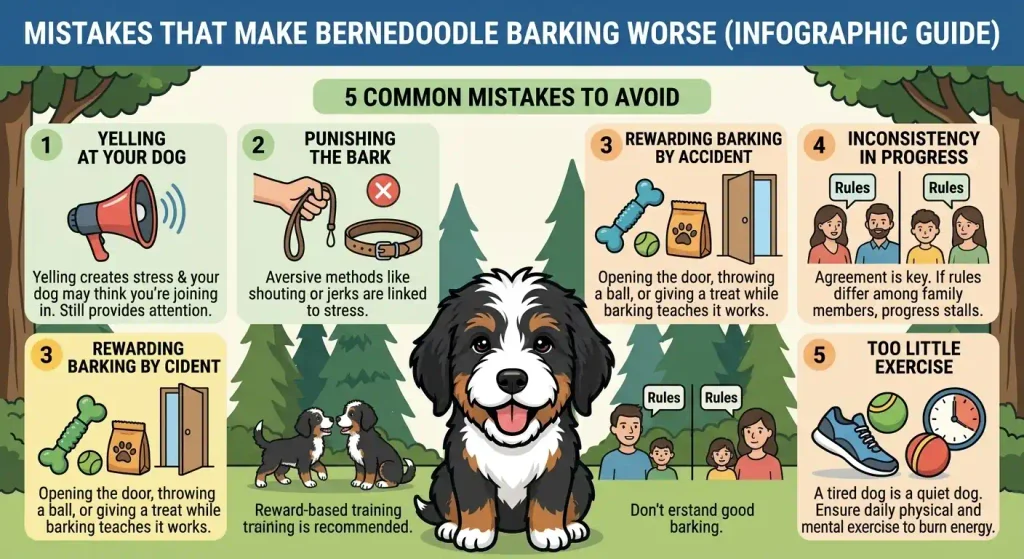
- Yelling. Your dog may think you’re joining in, and it’s still attention.
- Punishing the bark. Shock, spray and ultrasonic collars, and methods like leash jerks or shouting, are aversive. The American Veterinary Society of Animal Behavior’s humane dog training position statement recommends reward-based methods for all training and warns that aversive methods are linked to stress. For a dog who barks from fear, punishment can make it more afraid of strangers.
- Rewarding barking by accident. Opening the door, throwing the ball or giving a treat while your dog is barking teaches it that barking works.
- Inconsistency. If one family member rewards quiet and another lets the dog bark for attention, progress stalls. Agree on the rules together.
- Too little exercise. A Bernedoodle with energy to burn will often spend it on barking.
When to talk to your vet or a trainer
See your vet if barking starts suddenly, especially in an older dog, or comes with other changes like restlessness at night, confusion or signs of pain. Pain, hearing loss and cognitive changes can all cause new barking.
Work with a certified, reward-based trainer or a veterinary behaviorist if your Bernedoodle growls, lunges or snaps at people, barks nonstop when left alone (a possible sign of separation anxiety), or isn’t improving after a few weeks of consistent practice.
Frequently asked questions
Are Bernedoodles good watchdogs? Many Bernedoodles will bark to let you know someone is at the door, but they’re usually too friendly to be guard dogs. Think doorbell, not bodyguard.
At what age do Bernedoodle puppies start barking? Most puppies start making barking sounds within their first few weeks of life, and they find their real “voice” as they settle into their new home. Starting quiet training early is easier than fixing a habit later.
Do Mini Bernedoodles bark more than Standard Bernedoodles? There’s no breed data comparing them. Barking depends more on the individual dog, its training and its daily routine than on its size.
Will my Bernedoodle grow out of barking? Some puppy barking fades as puppies mature, but barking that gets rewarded usually becomes a habit. Training it early is the best way to make sure it fades.
Are bark collars safe for Bernedoodles? Veterinary behavior experts recommend reward-based training instead. Bark collars work by punishment, which can increase stress and fear. Use the steps in this guide, and get help from a reward-based trainer if barking doesn’t improve.
The bottom line
Bernedoodles aren’t naturally noisy dogs, but they’re smart enough to learn that barking gets results. Work out why your dog is barking, stop rewarding it, reward quiet instead, and slowly teach your dog that strangers and doorbells are nothing to worry about. With patience and treats, most Bernedoodles go back to being the calm teddy bears you fell in love with.


One Comment